
Keywords
Categories
How to Cite
Abstract
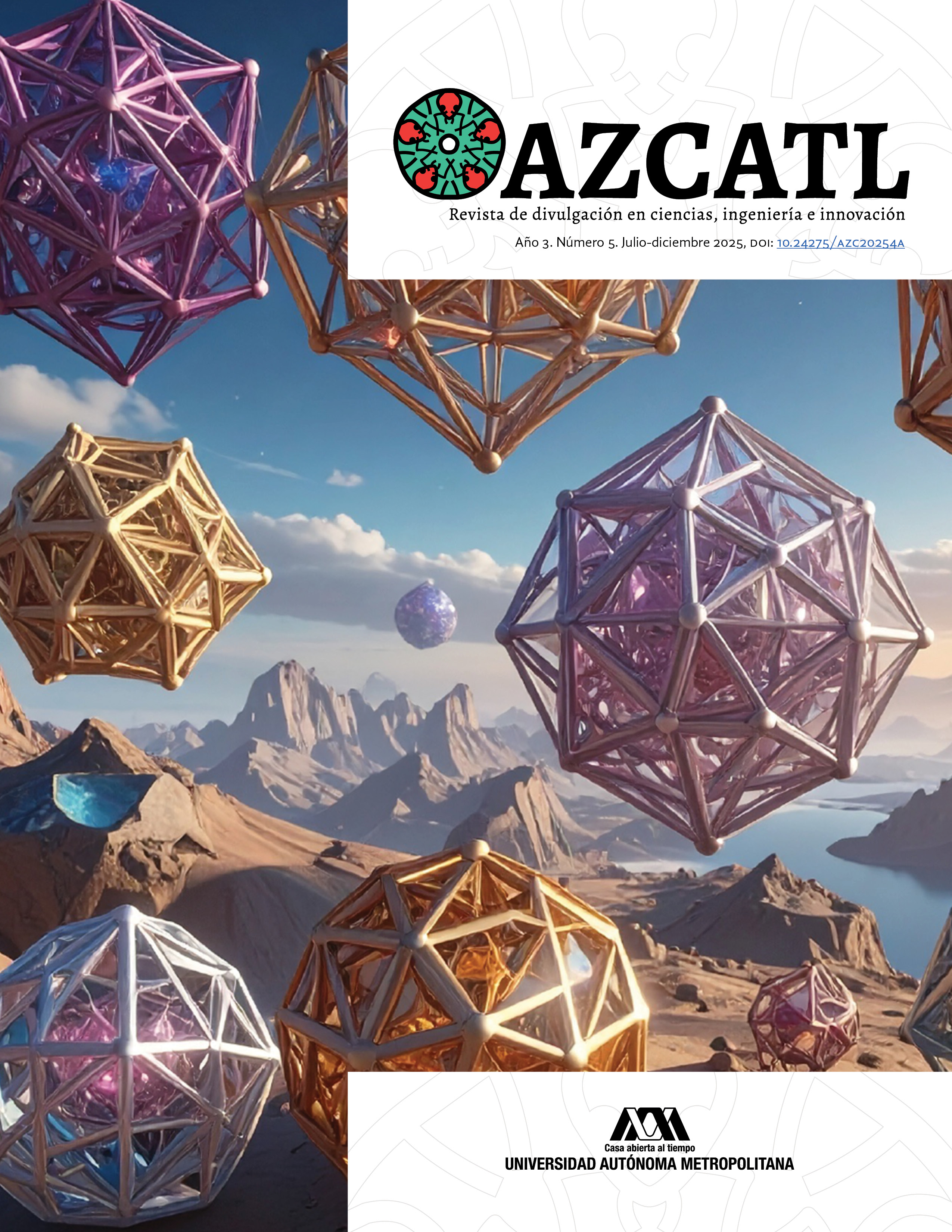
Geometry, and much less mathematics, are concepts we generally don't consider in our daily lives; however, they are present every day, forming a fundamental part of modern civilization. Triangles, in particular, discreetly appear in constructions, in art and design, in science and technology, in nature, and in some cases as part of our sense of integration with the universe.
References
Hibbeler, R. C. (2016). Engineering Mechanics: Statics (14a ed.). Pearson.
Salvatori, M. & Heller, R. (1986). Structure in Architecture: The Building of Building. Prentice Hall.
Sagan, C. (1980). Cosmos. Planeta.
Hughes, J.F., Van Dam. A., McGuire, M., Sklar, D. F., Foley, J. D., Feiner, S. K., y Akeley, K. (2014). Computer Graphics: Principles and Practice (3a ed.). Addison-Wesley Professional.
Kemp, M. (2006), Leonardo da Vinci: Las maravillosas obras de la naturaleza y el hombre, Ediciones Akal.
Cirlot, J. E. (1997). Diccionario de Símbolos, Siruela.

This work is licensed under a Creative Commons Attribution-NonCommercial-NoDerivatives 4.0 International License.
Copyright (c) 2025 Universidad Autónoma Metropolitana